
 Mr Nitin Gadkari, Union Minister of Road Transport and Highways, said that his ministry would review the existing provisions governing subcontracting of highway works to ensure that contractual requirements are strictly adhered to and that responsibility for quality and timely execution remains clearly with the principal contractor.
Addressing the 4th edition of FICCI’s Tunnels and Bridges Conference, Minister Gadkari said the ministry was already assessing contractors on the basis of their performance and had begun extending the exercise to consultants preparing detailed project reports (DPRs), with tender eligibility proposed to be linked to such performance assessments. “Quality is the first priority, and cost comes after quality,” he said.
The Minister cited instances of contracts being awarded substantially below the estimated cost and subsequently being subcontracted through multiple layers, with each intermediary retaining a margin. He said that goods and services tax records could help trace such chains of subcontracting and identify instances where contractual requirements may have been breached.
The Ministry is preparing tunnel tenders worth Rs 2000 billion to Rs 2500 billion. The Minister encouraged the industry to lead on domestic manufacture of tunnel boring machines, whose capital cost he identified as a binding constraint, and to convene a technical session on ultra-high-performance concrete.
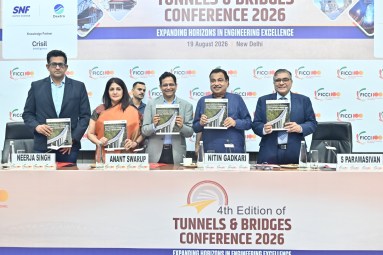 Mr S Paramasivan, Chair, FICCI Committee on Roads and Highways and Managing Director, Afcons Infrastructure, placed four industry concerns. He said the predominant use of L1, or lowest-bid, award was producing tenders 20 per cent or more below estimated cost, putting commercial viability and execution quality under pressure. Provisions for quality-cum-cost based selection already exist at the finance ministry and MoRTH but see little use, he said, urging their adoption as the preferred method for complex projects and those above Rs 10 billion, with technical parameters weighted at 70 to 80 per cent.
Paramasivan also called for land acquisition and clearances to sit with project authorities rather than contractors under engineering, procurement and construction terms; for item-rate or equivalent provisions to compensate verified geological variations in Himalayan tunnelling; and for the June 2024 procurement guidelines steering disputes above Rs 1 million towards mediation to be reconsidered, arguing that institutional arbitration with time-bound procedures was preferable to years in the courts.